

Something is rotten in the state of mathematics. Across every social media feed I follow, mathematicians are grieving OpenAI’s release of shoddy, verbose solutions to some of math’s most important open problems. And this is only the latest in a rapid succession of AI achievements that have left the math community increasingly unsettled. To get the overall Zeitgeist, watch this candid video by last-year PhD student and math communicator Sophie Maclean. She confesses:
“I have spent the past couple of days quite upset. I have cried a few times. It feels like a grief […] I am scared that I have lost the maths I love.”
The top comment on this video as of writing is “Mathematicians can join us software engineers to work at Starbucks.” But this comparison misses what I consider the video’s key point. Mathematicians’ grief is different from the concerns of other groups, like web designers or software engineers, about automation.
Mathematicians working on the kind of problems AI disrupts are pretty isolated from market demand and supply dynamics. Proofs were never a “product” society consumed the way websites or backend APIs are. Whether a year in pure mathematics was slow or productive made little immediate difference to the world outside of math. When software engineers express their own grief about AI, much of it comes from moving into a reality where fewer of them can create the increasingly large supply of code needed to keep the world running. (Although whether the world will just use more lines of code begs the question.)
In contrast, the pressures organizing mathematicians’ work come from within their discipline. They decide what is meaningful or elegant, and really, no one else has much say in it. This differs from how we treat scientists in other fields, especially applied ones, where, for example, medical research has more immediate accountability. But “The Unreasonable Effectiveness of Mathematics in the Natural Sciences” has given mathematicians a powerful justification for their autonomy, as ideas pursued for their own aesthetic ideals turn out to be indispensable decades later.
Math is thus, dare I say, peak Ivory Tower. They enjoy a remarkable degree of freedom to decide what is worth pursuing, and society largely accepts that what they do is important enough to leave them to it. This is not a privilege afforded, for example, to humanities scholars who are regularly asked to justify why their work matters.
My hot take is that mathematicians’ grief comes in no small part from the shattering of this special position they occupied. Mathematicians have often justified their work by pointing to hard, unsolved problems, and solving them requires developing deep understanding and finding elegant abstractions. The end and the means were aligned, to use AI’s language.
Enter AI, which threatens to drive a wedge between how mathematicians do math and how to efficiently obtain results mathematicians find important. The best path may not always be the most intellectually satisfying one; instead, it may involve generating thousands of ugly intermediary results and leaning too heavily on computation rather than understanding.
To some extent, mathematicians are late to the party. The AI crowd themselves have gone through a version of this crisis 10 years ago. In his famous NeurIPS keynote, Ali Rahimi compared “modern” machine learning to alchemy, complaining that researchers were building increasingly powerful neural networks through experimentation and accumulated tricks, with nothing resembling deep understanding.
If history is any guide, mathematicians won’t be very pleased with what happened next, because this extremely empirical approach towards machine learning won. Researchers kept scaling models, and tweaking training recipes, and throwing more compute and money at hard problems. Progress came mostly from iteratively trying new approaches on shared tasks (benchmarks, if you will), and this build-and-test empiricism in machine learning drove the current language model paradigm and its many successes.
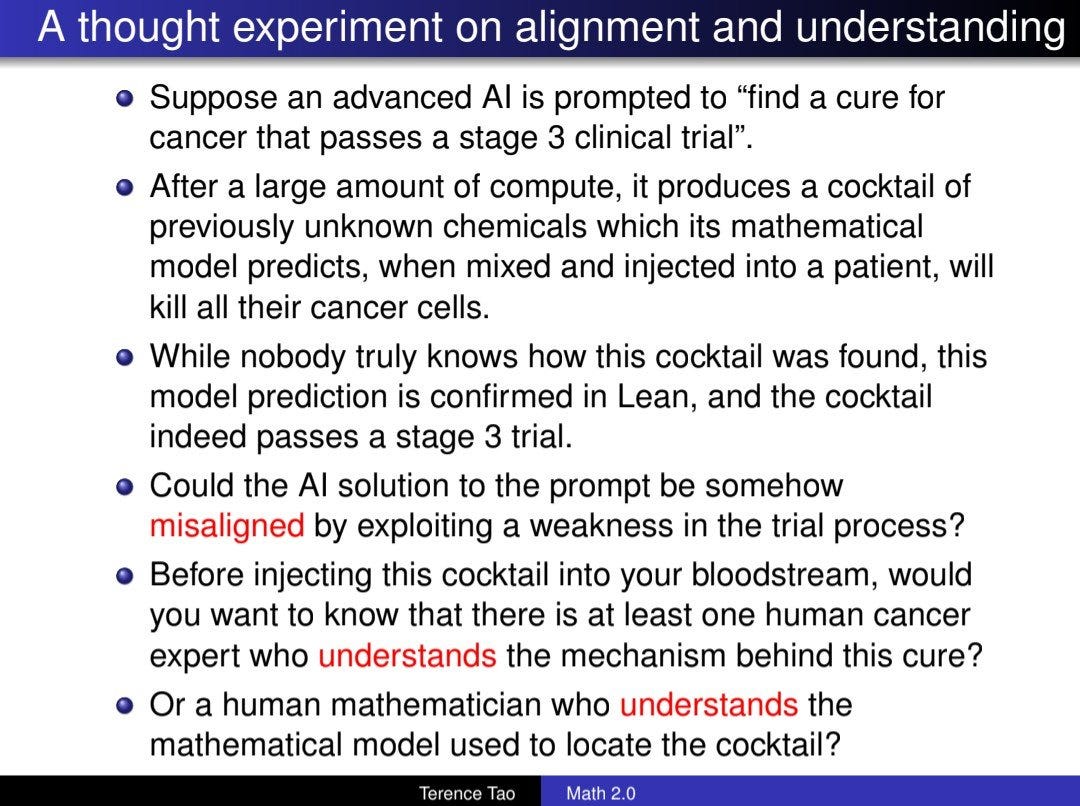
Ultimately, people don’t care about understanding as long as they get what they want (who’s they, though? More on this later). A slide from Terry Tao’s Math 2.0 lecture captures this bargain: it asks us to imagine AI producing a verified cancer treatment that passes a clinical trial. Would you still want a human expert to understand how it works? I think that Terry wants you to say yes, but he doesn’t flesh out the whole circumstance: what if this lack of understanding comes at the cost of 10x more cancer treatments? Or 100x? I think people would be fine not knowing. As Twitter notes, we still don’t quite understand how paracetamol works.
But here’s the catch, and where I believe mathematicians may find some hope. External pressure on mathematicians to maximize output remains relatively weak. No customer is waiting for the next quarter’s shipment of proofs. This could change: society may become less willing to fund humans when machines can produce results more cheaply. But for now, mathematicians still have the authority to decide what mathematics is.
In that regard, I think calling old math “Math 1.0” and announcing the era of “Math 2.0” is absolutely the right move. Tao is using his authority within the discipline to move the goalposts and, once again, align the discipline’s goals with the qualia of doing mathematics that drives the community. But that task may be harder than it seems: academia operates within a very specific reward structure that involves journal publications, the gruesome process of getting an academic job, and then eventually getting tenure.
The question ahead of math is thus twofold: 1) can mathematicians develop new yardsticks that reward what they truly value about doing mathematics in the age of AI? And 2) will those yardsticks hold as AI gets better?