

AI Detectors Have Been Proven to Be Biased
Every other day, the social media network formerly known as Twitter goes into a tantrum about Pangram and AI detectors more broadly. The factions and takes reorient themselves around the latest news. Most recently, it was about whether Pangram scores would be biased against African writers.
Why? Because the Caine Prize for African Writing, recently awarded to “The Blue Fighter,” yields 100% AI in both Pangram and GPTZero, the two most prominent AI detectors. However, the institution that gave the award has recently acquitted the author of any wrongdoing. Funny enough, the Instagram post about said news couldn’t be more AI-written, describing the review as: Human-centred. Evidence-led. Thorough.
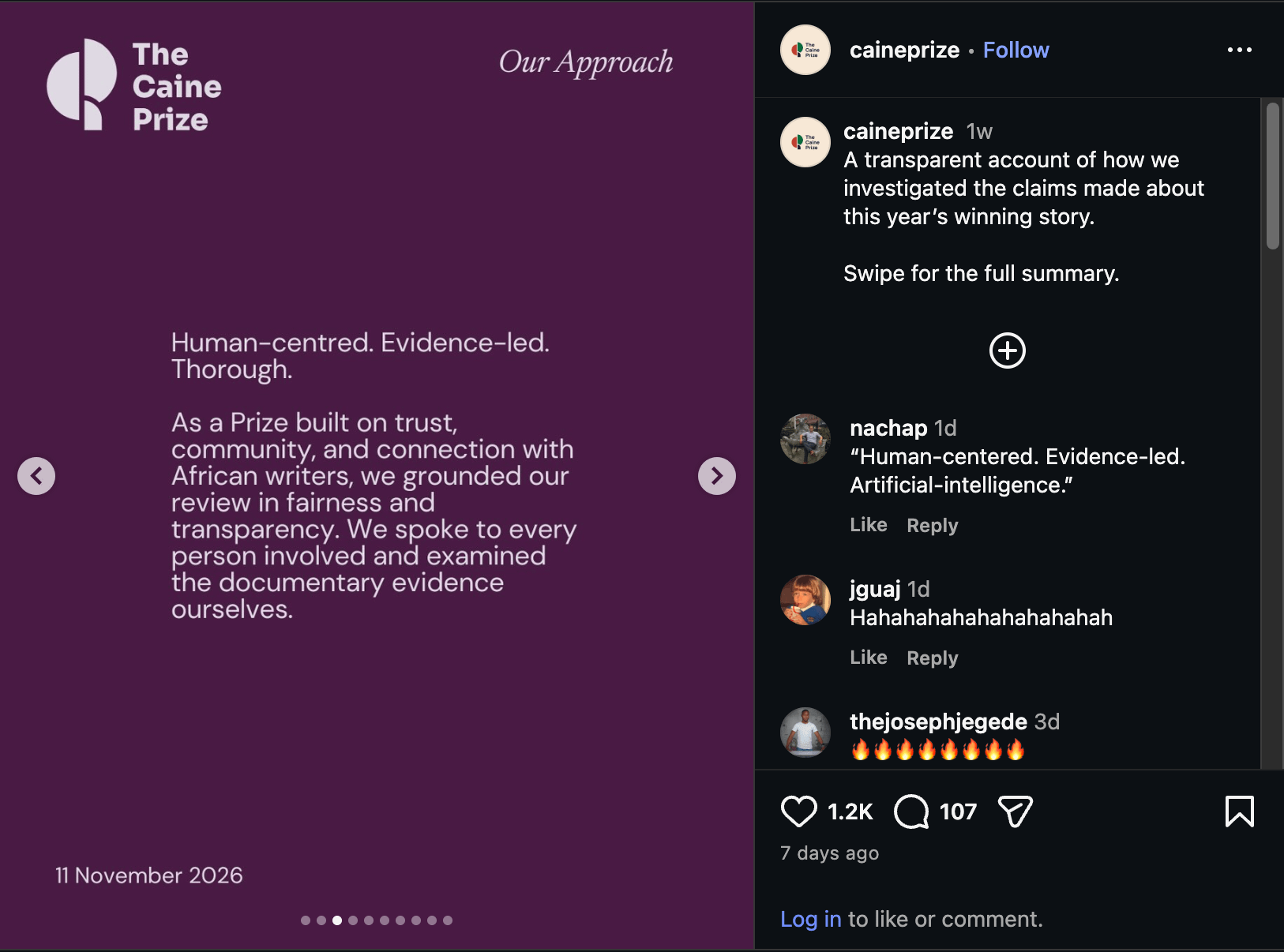
After the controversy, I actually read Simbarashe Kundizeza’s short story. It is a good one, and not “sloppy,” in my subjective aesthetic judgment. I think we should collectively treat it as not AI-generated, given the audit and the tremendous impact a false positive can have on the authors’ careers. But broader calls to completely discredit AI detectors because of this result are not statistically sound. I won’t elaborate much here, because there are already tremendously good pieces on this by Jessica Hullman and Tuhin Chakrabarty.
In short, the overwhelming evidence suggests that Pangram is pretty darn good at distinguishing AI from non-AI text. This evidence is particularly strong when analyzing text from the pre-ChatGPT era. Subsequent analysis by Tuhin suggests that neither Pangram nor GPTZero seems disparately biased against older pieces by writers from Africa or the diaspora. Whether this has changed dramatically for current texts remains an open question, though some recent evidence suggests Pangram is not merely memorizing text. So, jumping to the conclusion that Pangram or GPTZero systematically bias newer texts written by African writers is unwarranted and anecdotal.
Math is Dead
Every few months, AI companies claim to have solved another Millennium Prize Problem. In September, OpenAI claimed to have found a solution to Navier–Stokes, around the same time as NYU’s Tristan Buckmaster and Anthropic’s Levent Alpöge. More recently, Alpöge, who is not only probably a brilliant mathematician but also an excellent shitposter, has claimed to have found a solution to the Riemann Hypothesis.
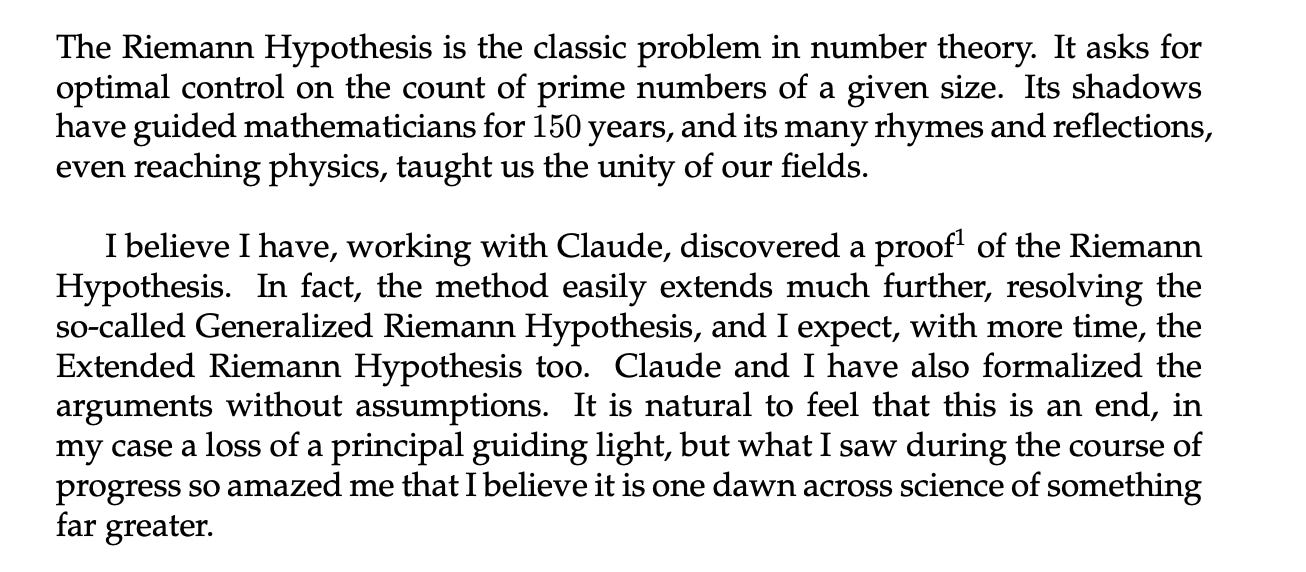
These advances are being done in a way that is quite disruptive to mathematics, forcing the community to find new goalposts that align with the qualia of doing mathematics. To understand why, it may be worth downloading the Lean proof Alpöge posted alongside their results. Or, I mean, the 14 zip files containing the proof.
Twitter profiles with anime pictures did not wait more than 15 minutes to declare the whole field of mathematics dead. But reality is just weirder; mathematics has arguably always been meant to produce human understanding. And it just so happens that producing this understanding will have a tremendous empirical component; like biologists, they will increasingly determine whether things are true long before understanding why.
This is not to say that this shift isn’t shaking the discipline to its core. It isn’t entirely new: the computer-assisted proof of the Four Color Theorem was arguably just as insane in 1976, and many mathematicians met it with dismay. But the sheer generality of this new empirical paradigm threatens how mathematicians are trained and what they prize about doing mathematics. Still, worry not, my mathematician friend: I’m pretty sure @eaccwaifu22 won’t be the one explaining these Lean proofs to us anytime soon.